Clean water is the most important chemical reagent in a laboratory. PN-EN ISO 3696:1999 offers water production systems that meet the parameters of each water purity class specified in the ASTM, CLSI, and FP standards. The quality of water in a modern laboratory must remain consistent and appropriate depending on its use, and its parameters (e.g., conductivity and temperature) must be continuously monitored. The main water quality standards in force in Poland are PN-EN ISO 3696:1999 for analytical laboratories and Pharmacopea Polska IX for pharmaceutical laboratories.
PN-EN ISO 3696:1999 defines three water purity classes:
Class 1: Water free of diluted contamination (colloidal, ionic, or organic) that meets the most stringent analytical requirements, including high-performance liquid chromatography. It is recommended that water of the second purity class be obtained by further processing (filtration through a 0.2 μm membrane for substance removal or double distillation in a quartz apparatus).
Class 2: Water with very low inorganic, organic, and colloidal contamination. It should be obtained by deionization or reverse osmosis.
Class 3: General-purpose water used for "wet" chemical tasks. It is obtained by single distillation, deionization, or reverse osmosis.
What is Distilled Water?
Distilled water is pure water obtained by boiling and evaporating water, followed by condensation. This process removes:
• Minerals,
• Salts,
• Microorganisms,
• Soluble chemicals.
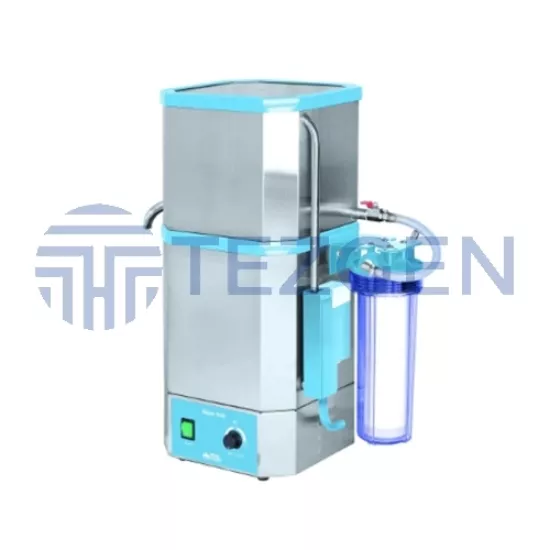
Distilled Water Production Devices:
Distillation systems generally consist of the following components:
• Boiler (with resistance)
• Cooler/condenser (condenser)
• Glass or stainless steel (to prevent reactivity)
Areas of Use:
• Laboratories
• Batteries (especially in the automotive industry)
• Autoclave devices
• Pharmaceutical production
What is Ultrapure Water (UPW)?
Ultrapure water is highly purified water that, beyond distillation, has been removed by more than 99.999% of all ions, particles, organic matter, and bacteria.
Purity levels are determined by standards such as ASTM, ISO, and CLSI. Type I ultrapure water, in particular, is the highest purity.
Ultrapure Water Systems:
Ultrapure water systems typically utilize multi-stage filtration:
1. Pre-filtration (activated carbon, sediment filter)
2. Reverse osmosis (RO)
3. Deionization (DI resins)
4. UV disinfection (organic matter breakdown)
5. 0.2 micron filtration (bacteria retention)
6. TOC measurement module (total organic carbon measurement)
Some devices continuously monitor:
• Conductivity (µS/cm)
• Resistivity (MΩ cm)
• TOC (ppb) values.
Areas of Use:
• Pharmaceutical industry (under GMP conditions)
• Semiconductor manufacturing (microchips)
• Analytical laboratories (sensitive devices such as HPLC, ICP-MS)
• Medical device washing
Differences Between Distilled Water and Ultrapure Water:
Properties: Distilled Water, Ultrapure Water
Purity Level: Medium (1-10 µS/cm)
Very High (0.055 µS/cm)
Production Method: Boiling and Concentration: RO + DI + UV + Filtration
Microbiological Cleaning: Medium
Very High
Application Area: General Laboratory, Battery, Critical Laboratory, Industry
Cost: Lower
High